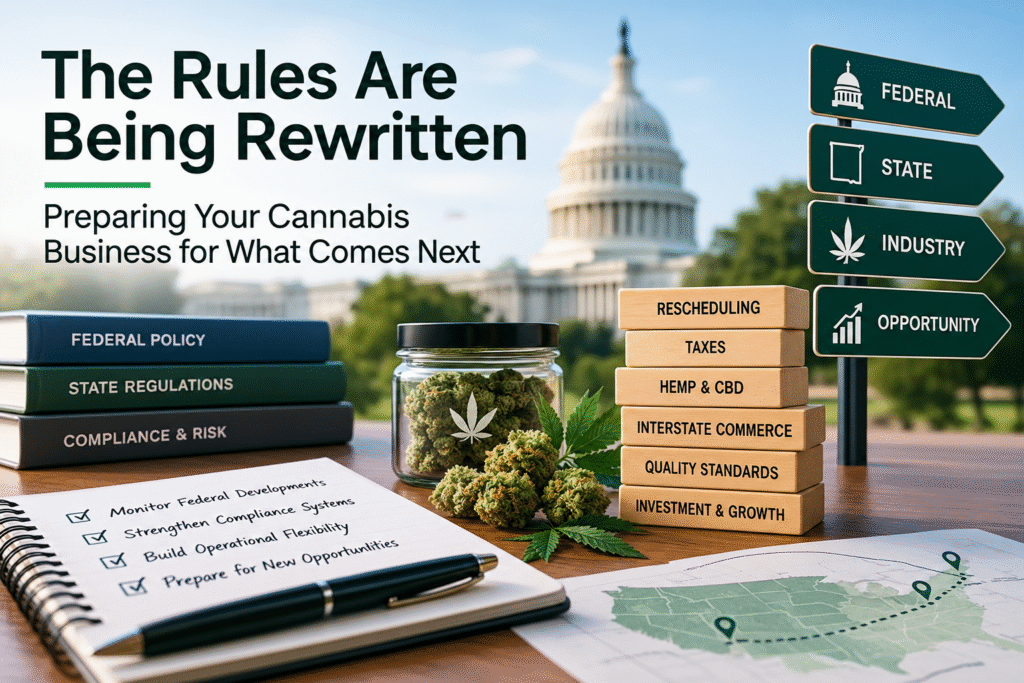

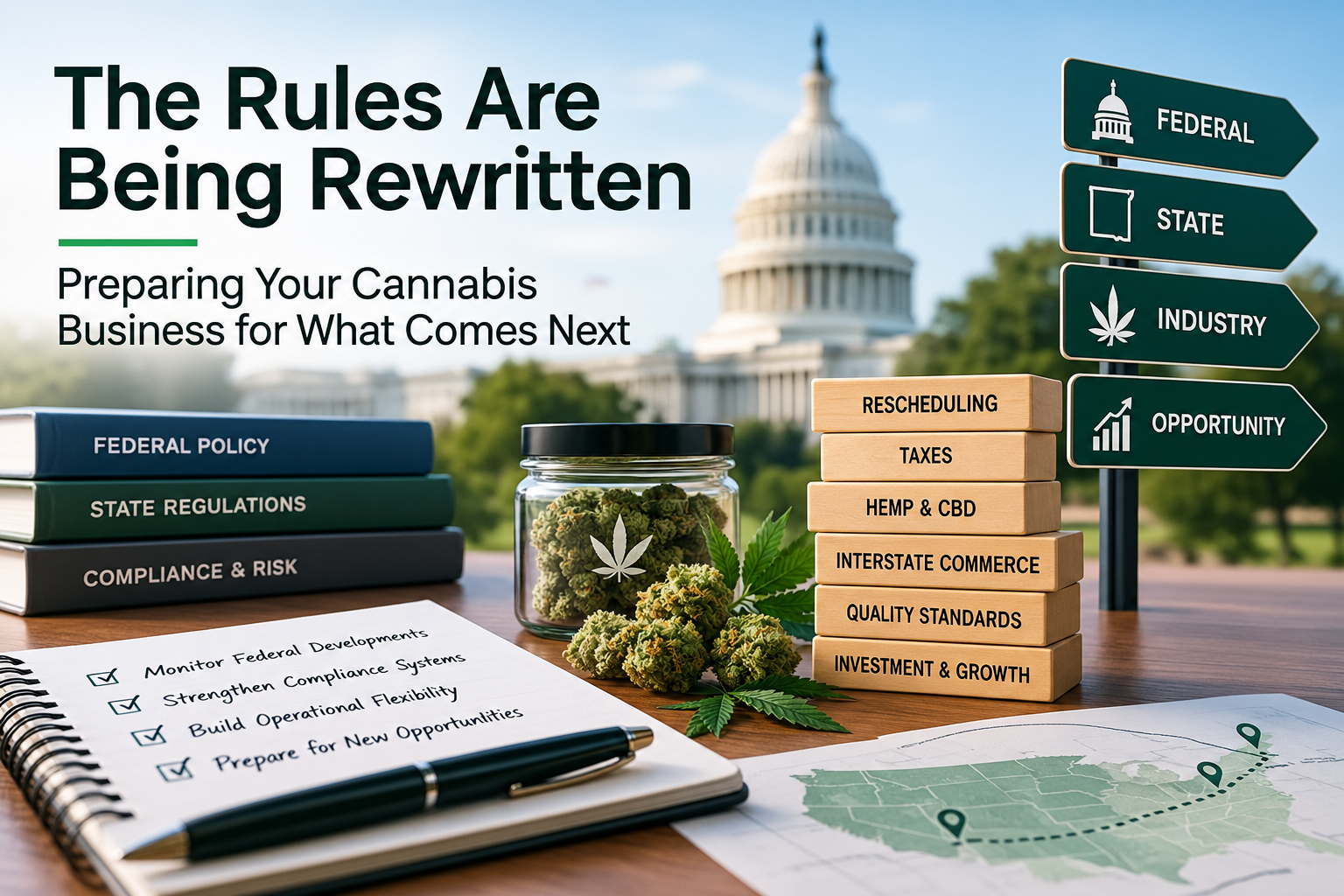
Preparing Your Cannabis Business for What Comes Next
For most of the legal cannabis industry’s history, operators have built businesses around a relatively stable assumption: cannabis regulation happens primarily at the state level.
The rules may change every year. Testing requirements evolve. Packaging standards are amended. Tracking systems change. New license types emerge. But the fundamental structure has remained recognizable. A state issues a license, establishes rules for operating under that license, and businesses build their compliance systems around those requirements.
That foundation may be approaching one of its most significant periods of change since state legalization began.
At the federal level, marijuana rescheduling remains unresolved following formal DEA proceedings held this summer concerning the proposal to move marijuana from Schedule I to Schedule III of the Controlled Substances Act. The hearing ran from June 29 through July 15, following the Department of Justice’s original 2024 proposed rule and a new hearing notice issued in April 2026.
At the same time, Congress continues debating the future treatment of hemp and cannabinoid products, while the cannabis industry is watching how federal agencies could ultimately interact with businesses that have spent years operating almost entirely under state regulatory systems.
None of these questions has a simple answer yet.
That may be the most important point.
For cannabis businesses planning 2027, the challenge isn’t predicting exactly what Washington will do.
It’s preparing a business that can adapt when we find out.
Schedule III Wouldn’t Be the Finish Line
Much of the cannabis industry’s discussion about rescheduling has understandably centered on taxation.
For operators that have spent years struggling under Internal Revenue Code Section 280E, the financial implications of moving marijuana to Schedule III could be substantial.
But focusing exclusively on taxation risks missing the larger question.
What does a federally recognized marijuana industry eventually look like?
Schedule III would not automatically convert today’s state-licensed cannabis businesses into federally compliant pharmaceutical companies, nor would it by itself resolve the legal status of every state adult-use market. The interaction among the Controlled Substances Act, DEA authority, FDA authority, state cannabis programs and future congressional action would still need to develop.
That means cannabis operators should be cautious about assuming that rescheduling simply removes federal barriers while leaving everything else untouched.
Federal recognition can create opportunities.
It can also create expectations.
Businesses operating in other federally regulated industries routinely encounter concepts such as quality management systems, documented training, supplier qualification, corrective and preventive action, validation, complaint handling, adverse-event reporting, recalls, document control and good manufacturing practices.
Exactly which requirements ultimately apply to which cannabis businesses will depend upon the regulatory framework that emerges.
But the direction of the conversation should matter to operators today.
State Compliance May Become the Foundation Rather Than the Finish Line
For years, cannabis businesses have understandably defined compliance by the requirements printed in their state’s rulebook.
If the state required it, they did it.
If the state didn’t require it, many businesses understandably questioned why they should spend scarce resources implementing it.
That approach made sense in an industry operating almost entirely within isolated state markets.
It becomes more complicated if those markets begin interacting with federal systems, interstate commerce or eventually international trade.
A company preparing to manufacture products under more rigorous quality standards may discover that years of documentation, supplier records, training records and process controls suddenly matter. A cultivator hoping eventually to supply markets outside its home state may encounter agricultural or quality standards that were never contemplated by its state license. Businesses pursuing institutional investment, acquisition or cross-border opportunities may be evaluated against expectations that go well beyond minimum state compliance.
The question therefore begins to change from:
“What does my state require me to do?”
to:
“What will my business need to demonstrate to participate in the market that comes next?”
Colorado Is Approaching Its Own Moment of Reassessment
Colorado provides a particularly interesting example.
The state built one of the country’s earliest comprehensive regulated marijuana systems and has spent more than a decade refining it. That system now governs an industry very different from the one that existed when legalization began.
Colorado’s Marijuana Code is presently scheduled for repeal on September 1, 2028 unless continued, with a sunset review occurring beforehand. Legislative materials identify October 15, 2027 as the scheduled publication date for the next sunset review, and recent legislation specifically requires DORA’s review to evaluate social-equity licensing and the independent delivery license.
That review will arrive while Colorado operators are already navigating mature-market economics, consolidation, testing and product-safety issues, changing business models and whatever federal cannabis framework emerges from Washington.
The result could be an important period of examination for Colorado’s regulatory system.
It would be premature to predict what Colorado policymakers will ultimately change.
But it is reasonable for operators to begin asking whether the compliance systems they built for yesterday’s cannabis industry are prepared for tomorrow’s.
Uncertainty Doesn’t Mean Doing Everything
There is a danger in conversations about federal readiness.
Businesses can easily be convinced that they need to immediately rebuild their operations around pharmaceutical standards that may never apply to them.
That isn’t practical, and for an industry already struggling with margins, it isn’t responsible.
A retail dispensary does not need to become a pharmaceutical manufacturer because marijuana might move to Schedule III. A cultivation business should not spend hundreds of thousands of dollars pursuing certifications without understanding whether those certifications serve a realistic business objective.
Readiness should begin with understanding the gaps.
What systems does the business already have?
Which ones work?
Where does the operation rely primarily on institutional knowledge rather than documented processes?
How mature are its training, quality, inventory and supplier controls?
Could the business demonstrate how it responds when something goes wrong?
Which improvements would strengthen the company today regardless of what happens federally?
Those questions allow businesses to prioritize investments rather than chase speculation.
Build Optionality
Perhaps the most useful concept for cannabis operators entering 2027 is optionality.
A well-documented operation has more options.
A business with reliable inventory controls has more options.
A manufacturer with strong supplier qualification, CAPA and quality systems has more options.
A cultivation facility that understands how its practices compare with broader agricultural standards has more options.
A company with SOPs that accurately reflect what employees actually do has more options.
These systems have value even if federal reform moves slowly.
They can improve efficiency, reduce mistakes, strengthen due diligence, support expansion, protect licenses and make businesses easier to manage.
If interstate commerce, federal regulation or international opportunities expand, those same systems become the foundation upon which the business can build.
That is why preparing for change does not require knowing exactly what change will occur.
AI Has Changed Compliance Too
There is another transition happening at the same time.
Operators now have unprecedented access to regulatory information and artificial intelligence tools capable of drafting policies, summarizing regulations and generating compliance documents in seconds.
That is a positive development.
Information that once required hours of research can increasingly be obtained almost instantly.
But information and implementation are not the same thing.
An AI system can generate an SOP. It cannot determine whether employees actually follow it. It can summarize a regulation. It cannot walk through a facility and determine whether the operation reflects that regulation. It can create a checklist. It cannot independently verify that the boxes deserve to be checked.
As compliance information becomes less expensive, professional compliance work will increasingly be about judgment, verification and implementation.
For operators with limited resources, that distinction matters.
Spend money where outside expertise actually creates value.
Preparing for Change, Not Predictions
Nobody can responsibly tell a cannabis operator exactly what the regulatory environment will look like a year from now.
The outcome of federal rescheduling remains unresolved. Congress can change federal law. Federal agencies will make their own regulatory decisions within whatever authority ultimately applies. States will respond to federal developments in different ways. Colorado will undertake its own sunset review.
Businesses cannot control those outcomes.
They can control how prepared they are to respond.
The strongest strategy heading into 2027 may therefore be neither ignoring federal developments nor spending heavily in anticipation of regulations that don’t yet exist.
It is understanding your operation well enough to know where you are strong, where you are exposed and what investments make sense under multiple possible futures.
After fifteen years in cannabis compliance, we’ve seen regulations change more times than we can count.
Rules change.
Markets change.
Administrations change.
Technology changes.
Businesses that understand their own systems are much better positioned to change with them.
Start With a Conversation
At iComply, we’re helping operators evaluate what federal and state regulatory changes could mean for their particular businesses without assuming that every company needs the same solution.
If you have a specific regulatory, operational or federal-readiness question, we offer affordable compliance advice and services to examine the issue and identify practical next steps.
If you’re simply trying to understand what these changes could mean for your business, start with a complimentary 30-minute conversation.
We’ll help determine what deserves your attention now, what can wait, and where additional work may—or may not—be worthwhile.
Schedule a Complimentary 30-Minute Call
Prepare for change. Don’t pay for predictions.