

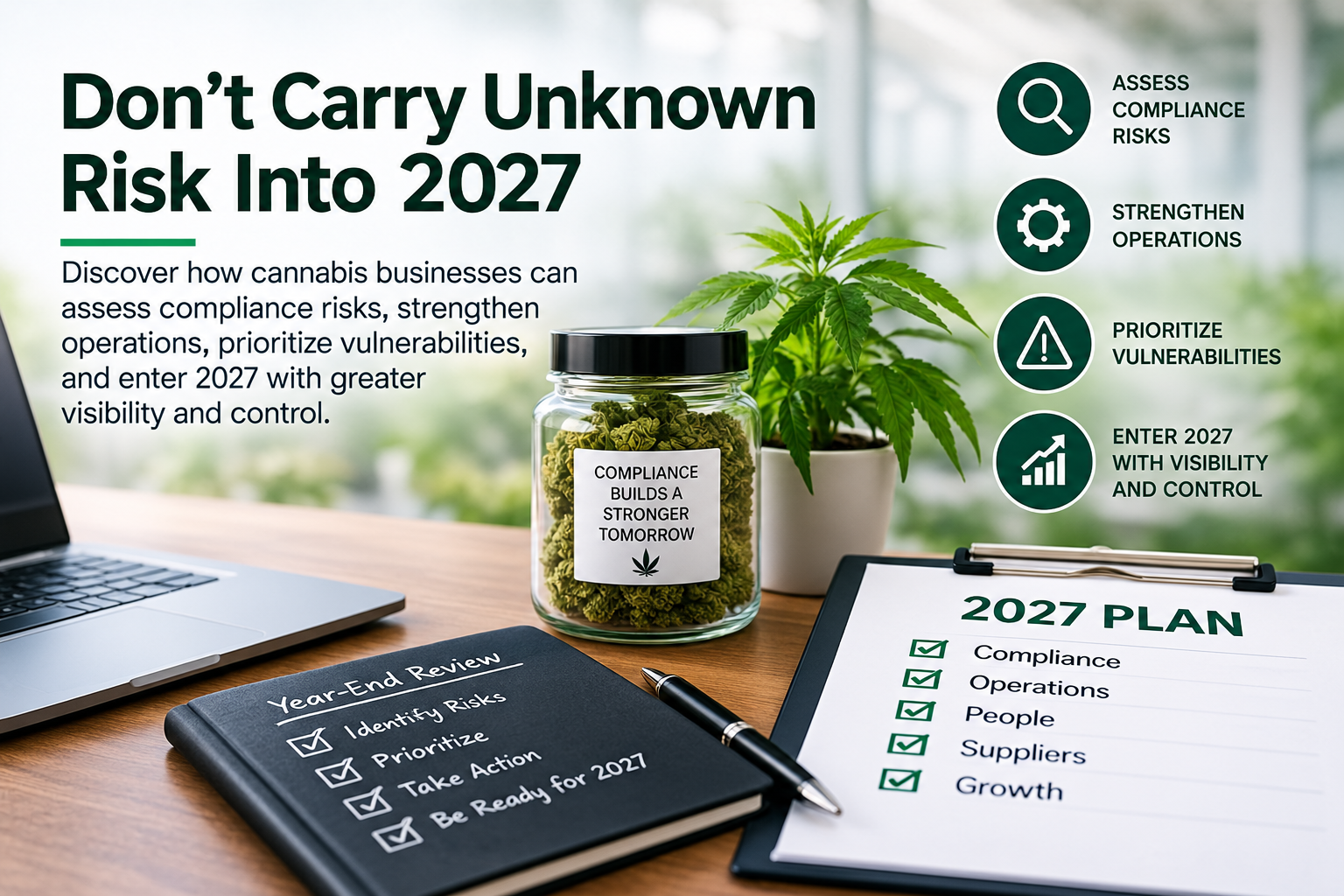
What Cannabis Operators Should Know About Their Business Before the Year Ends
There is rarely a convenient time to discover a compliance problem.
It usually happens when someone else starts asking questions.
A regulator requests records. An inventory discrepancy cannot be reconciled. A product becomes subject to a Health and Safety Advisory. An employee leaves and takes years of institutional knowledge with them. An investor begins due diligence. A buyer looks more closely at operations. A new manager discovers that the SOP and the actual process have very little in common.
Suddenly, something that may have existed quietly for months becomes urgent.
As 2026 comes to an end, cannabis businesses have plenty of reasons to conserve cash and avoid unnecessary projects. Margins remain difficult in mature markets. Regulatory uncertainty continues. Many operators are already asking how federal changes could affect their businesses in 2027.
That makes this a particularly bad time to spend money fixing things that aren’t broken.
It also makes it a very good time to understand what actually is.
Before carrying another year of operational and compliance risk forward, cannabis operators should know where their most significant vulnerabilities are, which ones require attention, and which ones can reasonably wait.
That is different from trying to become “100% compliant.”
After 15 years of auditing cannabis operations, we don’t believe that’s a particularly useful objective.
The better objective is visibility and control.
The Risks You Know About Are Usually Easier to Manage
Most experienced cannabis operators know their businesses aren’t perfect.
There is an SOP that needs updating. Training documentation could be better. Inventory discrepancies take too long to resolve. A recurring operational problem has become accepted as “just how we do it.” Management knows a process should be improved but hasn’t had the time or money to address it.
Those aren’t necessarily catastrophic problems. In fact, identifying them is the first step toward managing them.
Unknown risk is different. It’s what you don’t know that you don’t know that is most damaging.
Unknown risk exists when management believes a control is working but nobody has verified it. It exists when employees have developed workarounds that leadership doesn’t know about. It exists when a written procedure satisfies a regulatory requirement on paper but doesn’t reflect what happens on the floor.
It exists when a company relies on a vendor without understanding the risks entering through that relationship.
It exists when nobody has tried to reconstruct a batch, trace a transaction, investigate a deviation or test whether the recall procedure actually works.
And it exists when everyone assumes somebody else is responsible.
Those are the risks worth finding.
An Audit Shouldn’t Be a Hunt for Violations
Compliance auditing has sometimes been treated as a search for everything a business is doing wrong.
That can produce a very impressive report. It doesn’t necessarily produce a better business.
A useful operational assessment should distinguish among different kinds of findings.
Some issues may create immediate regulatory or product-safety exposure and deserve prompt attention. Others may represent recurring weaknesses that are not emergencies but could become expensive if ignored. Some are documentation problems. Some are training problems. Some are management problems disguised as compliance problems.
And some technically imperfect practices may present relatively little practical risk compared with everything else competing for the company’s resources.
That distinction matters, especially now.
Cannabis operators do not have unlimited compliance budgets. Management needs to know what matters most.
The purpose of an independent assessment should therefore be less about generating the longest possible deficiency list and more about answering three questions:
- What is our exposure?
- What should we address first?
- What can wait?
That’s actionable compliance.
Your SOP Binder Isn’t the Answer
Artificial intelligence has made it easier than ever to create policies, procedures, checklists and training materials.
That is useful.
An operator can now draft an SOP in minutes that might once have taken hours. Regulations can be summarized quickly. Templates are readily available. Existing documents can be rewritten and organized with very little effort.
But that makes verification more important, not less.
A professionally formatted SOP does not demonstrate that the procedure works.
The real questions are whether the procedure matches the facility, whether employees understand it, whether they actually follow it, whether required records are generated, and whether management can tell when the process fails.
A tool is only as good as the person using it. The same is true of compliance documentation.
The value of an assessment is not determining whether you have an SOP titled “Inventory Control.”
It is determining whether inventory is actually controlled.
Follow the Operation, Not Just the Rulebook
One of the most useful ways to evaluate a cannabis business is to follow what actually happens.
- How does the product enter the operation?
- Who receives it?
- What gets verified?
- Where is it recorded?
- Who can move it?
- What happens when physical inventory and the tracking system disagree?
- How does material move through cultivation or production?
- Where can contamination, diversion, mislabeling or simple human error occur?
- Who notices when something goes wrong?
- How do they catch it?
- What happens next?
Those questions naturally move across traditional compliance categories.
Inventory connects to security. Training connects to SOPs. Purchasing connects to supplier qualification. Manufacturing connects to quality control. Product complaints connect to traceability. Traceability connects to recalls. Deviations connect to Corrective and Preventive Action.
That is why mature compliance programs increasingly look less like collections of individual rules and more like systems.
Weakness in one system often creates problems somewhere else.
Look at the Problems You’ve Already Had
One of the best predictors of where an operation needs attention is its own history.
What went wrong this year?
- Inventory discrepancies?
- Failed tests?
- Employee mistakes?
- Security incidents?
- Customer complaints?
- Rejected transfers?
- Packaging or labeling errors?
- Regulatory findings?
- Equipment failures?
- Products placed on hold?
- Vendor problems?
The important question isn’t whether something went wrong. Something eventually goes wrong in every operation.
The important question is what happened afterward.
- Was the cause investigated?
- Was it documented?
- Did anyone determine whether the same issue could exist elsewhere?
- Was a corrective action assigned?
- Did somebody verify that the corrective action worked?
- Or did everyone fix the immediate problem and move on?
That’s the difference between solving an incident and improving a system.
CAPA is valuable precisely because it creates a structured way to learn from mistakes rather than repeatedly paying for them.
Ask What Would Happen If Someone Left Tomorrow
People are another source of hidden operational risk.
Cannabis businesses often depend heavily on experienced managers and employees who know how everything works because they have been there for years.
That knowledge is valuable.
It is also fragile.
If the person responsible for inventory, compliance, cultivation, production or quality left tomorrow, could someone else reliably perform the job?
- Would they know what reports to review?
- Which recurring tasks need to happen?
- Where records are stored?
- Which vendors to contact?
- How are discrepancies investigated?
- Which regulatory deadlines matter?
- How does management know whether something has been completed?
A business that only functions because the right person remembers what to do has a key-person dependency, not a system.
Good documentation, defined responsibilities, recurring controls and cross-training turn individual knowledge into organizational knowledge.
That makes the business easier to operate, easier to scale and easier to transfer.
Know What You’re Handing an Investor or Buyer
Unknown risk also becomes expensive during due diligence.
A buyer or investor does not inherit only licenses, equipment, inventory and revenue.
They inherit the operation behind them.
Poor documentation, unresolved compliance issues, inconsistent inventory, weak quality controls, incomplete training records and processes dependent on particular employees can all complicate a transaction.
Finding those issues before due diligence gives the operator choices.
Management can correct the problem. Document the risk. Explain it. Price remediation. Or consciously accept it.
Discovering it after someone else does removes many of those options.
The same principle applies even if you have no intention of selling.
A business that can survive scrutiny is generally easier to manage.
Federal Readiness Starts With Operational Readiness
As we’ve discussed throughout this quarter, nobody can tell operators exactly what the federal cannabis framework will look like in 2027.
That shouldn’t prevent businesses from preparing.
Many of the fundamentals that matter under more mature regulatory systems are useful today: accurate records, controlled processes, employee training, traceability, supplier qualification, quality management, CAPA, internal auditing and management accountability.
Operators do not need to implement every pharmaceutical standard or pursue certifications they may never need.
They should know how far their existing operation is from the standards relevant to where they want to go.
That could mean remaining a strong Colorado operator.
It could mean expansion into another state.
It could mean preparing for investment or acquisition.
For some cultivators and manufacturers, it could eventually mean GACP, cGMP or participation in international supply chains.
Different destinations require different preparation.
The first step is knowing where you’re starting.
Don’t Try to Fix Everything Before January
A year-end assessment should not result in fifty new projects.
If it does, it may have failed.
The objective should be prioritization.
An operator might identify two issues requiring immediate correction, five that belong in the first-quarter plan, several documentation improvements that can be incorporated into ordinary operations, and a handful of longer-term improvements that only make sense if the business expands.
That’s manageable.
It also allows compliance spending to compete intelligently with every other demand on the business.
For an industry operating on tight margins, this is increasingly important.
Compliance cannot simply be another department asking for money.
It should help management understand risk well enough to decide where money actually needs to be spent.
Go Into 2027 Knowing What You Own
Every business carries risk into a new year.
The objective isn’t eliminating it. The objective is knowing what you’re carrying.
Before 2027 begins, cannabis operators should be able to identify their most significant compliance and operational vulnerabilities, understand the potential consequences, assign responsibility for the ones that matter and develop a realistic plan for addressing them.
That creates something more valuable than a clean audit report. It creates control.
After 15 years working inside regulated cannabis businesses, we’ve found that the companies best positioned to deal with change aren’t necessarily those with the thickest compliance manuals.
They’re the ones that know how their operations actually work. They know where the weaknesses are. They know who owns them.
And they know what they’re going to do next.
Start 2027 With a Clearer Picture
For the remainder of 2026, iComply is reserving limited availability for Comprehensive Operational Audits for cannabis businesses that want an independent look at their operation before carrying unresolved risk into another year.
Depending on the operation and scope, an assessment can examine regulatory compliance, SOP implementation, inventory and traceability, training, security, supplier and receiving controls, CAPA, HACCP and quality systems, documentation, management controls and readiness for future regulatory or business objectives.
The goal isn’t to hand you another binder.
It’s to identify and prioritize what deserves your attention.
If you’re not sure whether a full assessment makes sense, start with a complimentary 30-minute conversation.
Have a specific issue you already know you need to address?
Schedule a Complimentary 30-Minute Call
Don’t carry unknown risk into 2027. Know what you have, decide what matters.
