
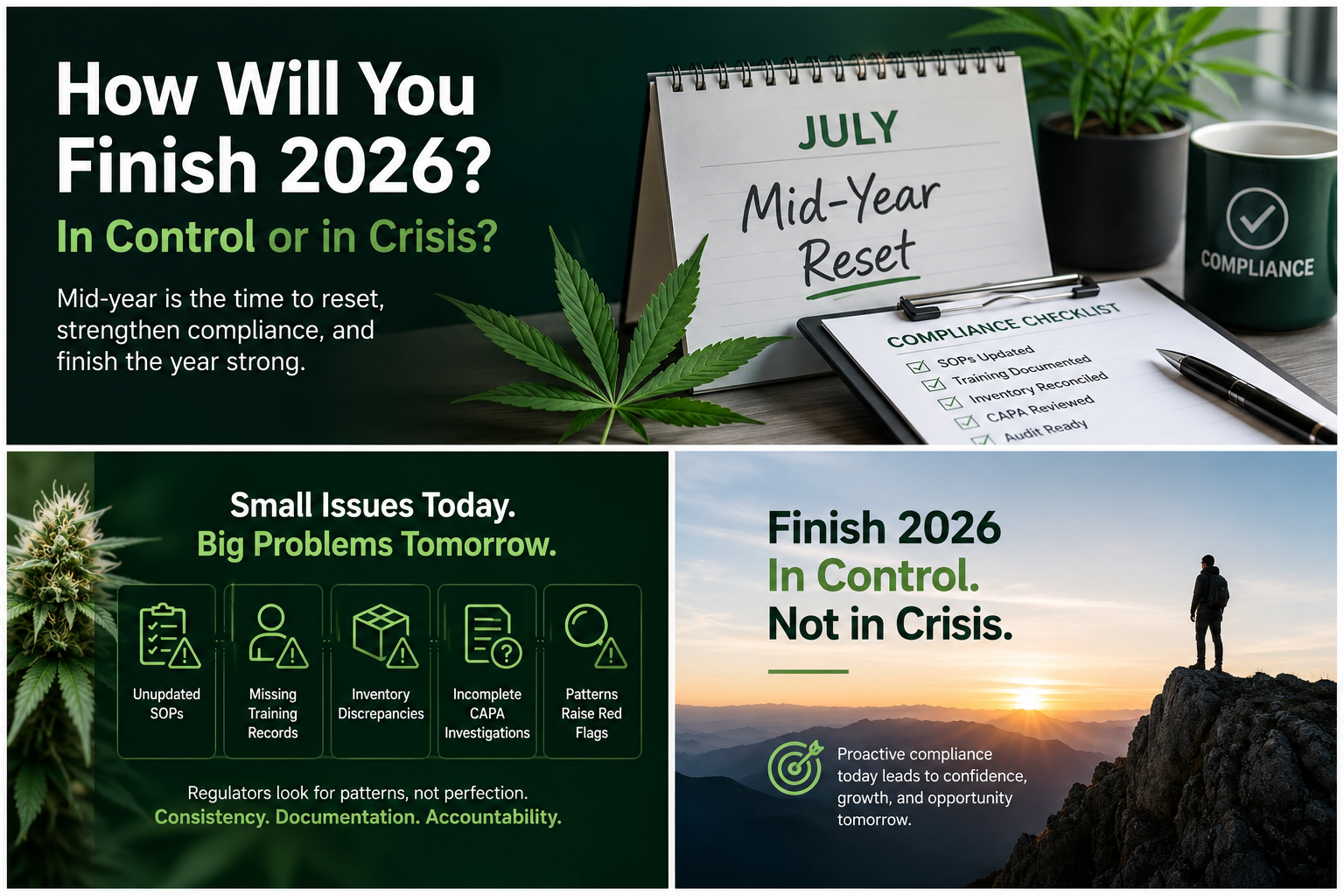
In Control or in Crisis?
January is when businesses set goals.
July is when those goals meet reality.
At the beginning of every year, cannabis operators commit to improving compliance, tightening operations, training employees, updating SOPs, and getting ahead of the next inspection. The intentions are always good. But six months later, the demands of running a business have a way of taking over.
The busy season arrives. Staff turnover happens. Inventory grows. Production increases. New laws have been passed. New regulations emerge. Customers need attention.
And compliance quietly slips down the priority list.
Not because operators don’t care—but because every day presents another urgent problem demanding attention.
The question isn’t whether that’s happened to your business.
The question is: how much, how often, and to what detriment?
Small Problems Rarely Stay Small
After more than fifteen years auditing cannabis businesses, we’ve learned something that surprises many operators.
We’ve never walked into a facility that was 100% compliant.
Not once.
That’s not because operators are careless. It’s because compliance isn’t static. It’s a living system that changes every day your business is open.
One inventory adjustment causes further delays.
A new employee never receives documented training.
An SOP gets updated operationally but not on paper.
A CAPA gets discussed—but never formally documented.
None of these issues are likely to shut down a business on their own.
But together, they begin telling a story.
And increasingly, that’s the story regulators are looking for.
Compliance Is About Patterns
Today’s enforcement environment is very different than it was even a few years ago.
Regulators are becoming increasingly sophisticated. They’re not simply looking for isolated violations—they’re evaluating patterns, consistency, documentation, and operational discipline.
An inventory discrepancy may not concern them nearly as much as repeated inventory discrepancies.
One failed test may be explainable.
Repeated failures without meaningful corrective action suggest something much larger.
Strong operators understand this distinction.
They’re not trying to appear perfect.
They’re trying to ensure their systems consistently produce compliant results.
July Is the Best Time to Reset
One of the biggest mistakes businesses make is waiting until renewal season — or worse, after an inspection — to evaluate their compliance program.
By then, the opportunity to prevent many issues has already passed.
Mid-year provides something far more valuable.
Perspective.
It’s an opportunity to ask difficult questions before someone else does.
- Are our SOPs still reflecting how we actually operate?
- Is our inventory telling an accurate story?
- Have we documented training consistently?
- Are CAPA investigations identifying root causes—or simply closing tickets?
- If an inspector arrived tomorrow, what would concern us most?
- Have we met the compliance goals we set at the beginning of the year?
These aren’t questions driven by fear.
They’re questions driven by leadership.
The Cost of Waiting
Many businesses view compliance as an expense that can be postponed until things improve financially.
Ironically, that’s often when compliance becomes most expensive.
Fines.
Product holds.
Administrative actions.
Consulting under crisis.
Legal expenses.
Lost investor confidence.
These costs almost always exceed what proactive planning would have required.
The businesses that finish the year in control don’t necessarily spend more on compliance.
They simply invest earlier—before small issues become expensive ones.
Looking Beyond Compliance
This year carries a different significance than previous years.
Federal rescheduling has changed the conversation around medical cannabis. Investment discussions are becoming more common. Operators are beginning to think about growth instead of simply survival.
That also means businesses will increasingly be evaluated through a different lens.
Investors don’t just examine revenue.
They examine operational maturity.
They want to know whether your business can scale consistently, produce reliable products, withstand regulatory scrutiny, and continue performing without relying on a handful of key individuals.
That confidence isn’t created during due diligence.
It’s built every day through disciplined operations.
Progress, Not Perfection
The goal has never been perfection.
It never will be.
The goal is visibility.
To understand where your operation is strong.
To identify where it’s vulnerable.
And to improve continuously before those vulnerabilities become someone else’s discovery.
The strongest operators aren’t the ones who never make mistakes.
They’re the ones who find them first. Afterall, you don’t know what you don’t know until you discover it.
Final Takeaway
There are two ways to spend the second half of the year.
You can spend it reacting to problems as they appear.
Or you can invest in refining the systems that prevent those problems in the first place.
One approach creates stress.
The other creates confidence.
As we move into the second half of 2026, ask yourself one simple question:
When December arrives, will your business be in control—or in crisis when the rules change again?
Because the answer isn’t determined at year-end.
It’s determined by the decisions you make today.
Ready for a Mid-Year Reset?
If you’d like an objective assessment of where your operation stands, iComply offers comprehensive Mid-Year Compliance Health Checks designed to identify operational gaps before they become regulatory issues. From SOP reviews and inventory reconciliation to training records, CAPA systems, HACCP planning, and operational audits, we’ll help you understand where you stand—and where to focus your efforts for a stronger finish to the year.
Manage your compliance before it manages you.