
Why Documentation Is Your Best Defense
Trust is one of the most valuable assets any cannabis business can build.
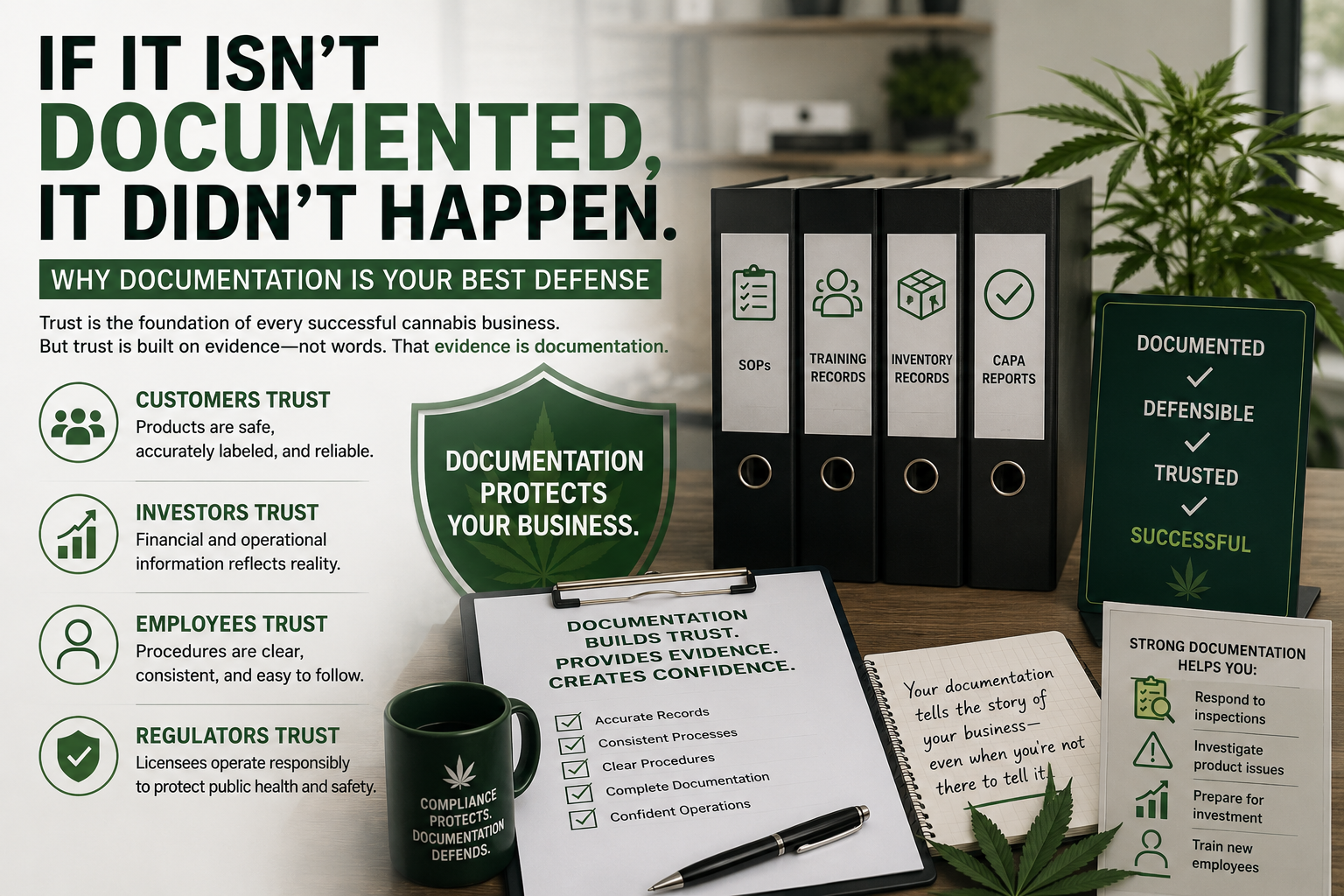
Customers trust that products are safe and accurately labeled. Investors trust that financial and operational information reflects reality. Employees trust that procedures are clear and consistent. Regulators trust that licensees are operating responsibly within the framework established to protect public health and safety.
But trust is rarely built through words alone.
In regulated industries, trust is built through evidence.
That evidence is documentation.
For many operators, documentation is viewed as one of the least exciting parts of running a business. It is often associated with paperwork, recordkeeping, or simply satisfying regulatory requirements. In reality, documentation serves a much greater purpose. It protects the business itself.
Whether you’re responding to an inspection, investigating a product issue, preparing for investment, or simply training a new employee, your documentation tells the story of how your business operates when you’re no longer in the room to explain it.
Your Business Can’t Run on Memory
Walk through almost any cannabis facility and you’ll hear statements like:
“We clean that every day.”
“Our employees are trained on that.”
“We always investigate failed testing.”
“We’ve never had an issue with that process.”
Most of the time, those statements are completely genuine.
The problem is that people leave. Managers change. Procedures evolve.
Months or even years pass between an event and the day someone asks about it.
Memory fades.
Documentation doesn’t.
Good documentation becomes the institutional memory of your organization. It allows every employee, manager, auditor, regulator, and future owner to understand not only what happened, but why it happened and how the organization responded.
Without that documentation, businesses rely on individual recollection. As operations grow, that becomes increasingly unreliable.
Documentation Isn’t About Regulators
One of the biggest misconceptions in cannabis is that documentation exists solely because regulations require it.
The truth is, the best operators use documentation to run better businesses.
Think about the questions that arise every day:
Why was inventory adjusted?
Which SOP was in effect when this batch was produced?
Has this employee completed the required training?
What maintenance has this piece of equipment received over the past year?
When was this corrective action implemented?
These questions aren’t just asked by inspectors. They’re asked by production managers. Owners. Quality personnel. Insurance companies. Investors. Attorneys. Future buyers.
Documentation doesn’t just satisfy compliance requirements—it provides answers that allow businesses to make informed decisions.
Documentation Turns Conversations into Evidence
Nearly every regulatory inspection, insurance claim, product complaint, or due diligence review begins the same way.
Someone asks:
“Can you show me?”
Not:
“Can you explain it?”
Not:
“Can you remember what happened?”
Show me.
Show me the training records.
Show me the maintenance logs.
Show me the sanitation documentation.
Show me the inventory reconciliation.
Show me the investigation.
Show me the corrective action.
In regulated industries, documentation transforms conversations into evidence.
And evidence carries far more weight than memory.
Every System Depends on Documentation
As cannabis continues moving toward greater operational maturity, businesses are hearing more about concepts like:
Current Good Manufacturing Practices (cGMP).
Good Agricultural and Collection Practices (GACP).
Corrective and Preventive Action (CAPA).
Hazard Analysis and Critical Control Points (HACCP).
Quality Management Systems.
At first glance, these may appear to be separate initiatives.
They aren’t.
Every one of them depends on accurate, consistent documentation.
An SOP isn’t valuable if employees aren’t trained to follow it. Training isn’t meaningful if attendance isn’t documented. A corrective action isn’t complete if no one records the root cause or verifies the solution.
Documentation is the thread that ties every quality system together. Without it, even well-designed compliance programs begin to unravel.
Documentation Builds Business Value
Documentation has another benefit that often goes unnoticed.
It creates confidence.
Businesses with well-maintained documentation are easier to manage, easier to scale, and easier to evaluate.
When investors conduct due diligence, they’re not simply looking at revenue.
They’re looking for operational discipline.
When insurers evaluate risk, they’re looking for consistency.
When lenders assess stability, they’re looking for repeatable processes.
And when regulators perform inspections, they’re looking for evidence that the systems you’ve designed are actually being followed.
Good documentation demonstrates all of those things.
It tells people your business isn’t dependent on a single individual remembering how something is done.
It tells them you’ve built a company capable of producing consistent results.
Documentation Should Make Your Business Better
Too often, documentation is treated as a regulatory obligation.
The best businesses treat it as an operational advantage.
Strong documentation helps identify trends before they become problems. It improves employee accountability. It reduces confusion between shifts. It accelerates training. It supports investigations. It strengthens quality systems. It provides clarity during periods of growth.
Most importantly, it gives leadership confidence that the business is operating the way it was intended to operate.
That confidence is difficult to achieve without documentation.
Final Takeaway
One of the oldest sayings in compliance is:
“If it isn’t documented, it didn’t happen.”
While that statement is often repeated, its meaning is sometimes overlooked.
Documentation isn’t valuable because regulators ask for it.
It’s valuable because it demonstrates consistency.
It protects institutional knowledge.
It creates accountability.
It builds trust.
As cannabis continues to evolve under increasing state and federal expectations, documentation will become one of the clearest indicators of operational maturity.
Not because the industry needs more paperwork.
But because the businesses that thrive will be those capable of demonstrating—not simply claiming—that they consistently do things the right way.
Documentation Is More Than Compliance — It’s Confidence
At iComply, we help cannabis businesses develop documentation systems that work in the real world. From SOP development and document control to training records, CAPA investigations, inventory reconciliation procedures, and quality management systems, our goal isn’t to create paperwork—it’s to build operational confidence.
Because good documentation doesn’t create compliance.
It demonstrates it.
And in an industry built on trust, that distinction matters.