

Why Reactive Compliance Always Costs More
Every business owner understands the concept of deferred maintenance.
A roof develops a small leak. It doesn’t seem urgent, so it waits until next quarter. Equipment begins making an unusual noise, but production schedules are busy and repairs can wait a little longer. A vehicle misses a recommended service interval because it’s still running well enough.
In the moment, postponing those decisions often feels practical. Resources are limited, priorities compete for attention, and nothing appears to be broken.
Until it is.
The cost of the original problem rarely remains the same. Water damage spreads beyond the roof. Equipment fails unexpectedly, bringing production to a halt. An inexpensive maintenance appointment becomes a costly repair or replacement.
Compliance follows much the same pattern.
Most regulatory issues do not begin as major violations. They begin as small decisions that seem reasonable at the time. An SOP update is postponed until operations slow down. A training record isn’t completed because everyone remembers attending the meeting. Inventory discrepancies are noted but not fully investigated. A corrective action is discussed informally rather than documented. Internal audits are pushed into the following quarter because production demands take priority.
None of these decisions appear significant on their own. In fact, many businesses continue operating successfully despite them.
The challenge is that compliance problems rarely remain isolated.
Small issues have a tendency to accumulate. One missing document makes it more difficult to reconstruct an investigation months later. An outdated procedure results in employees performing the same task differently between shifts. A recurring inventory discrepancy that initially seemed insignificant eventually reveals a deeper weakness in inventory controls. A quality issue that could have been resolved through a structured CAPA program begins appearing in multiple batches because the underlying cause was never fully addressed.
By the time regulators, investors, insurance carriers, or attorneys become involved, the original issue is often no longer the problem. The problem is the pattern.
This is one of the most important distinctions experienced operators eventually come to understand. Regulatory agencies are rarely interested in isolated mistakes. They recognize that every manufacturing environment, cultivation facility, and retail operation will occasionally encounter unexpected issues. What concerns regulators is whether those issues reflect isolated events or symptoms of a broader failure in the organization’s systems.
The same principle applies outside of regulation.
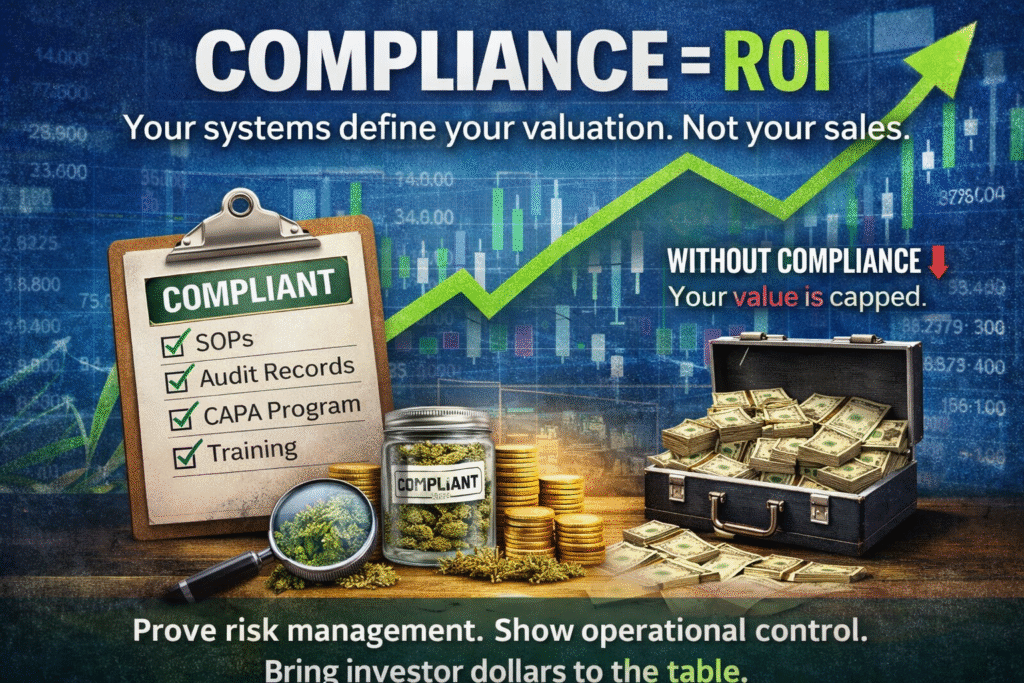
When investors conduct due diligence, they are not simply evaluating whether a business has experienced challenges. Every business has. They are evaluating how leadership identifies problems, investigates root causes, documents corrective actions, and prevents recurrence. Businesses that demonstrate disciplined continuous improvement inspire confidence. Businesses that repeatedly address the same issues without resolving their underlying causes create uncertainty.
Ironically, reactive compliance often becomes the most expensive form of compliance.
Businesses frequently postpone proactive assessments because they view compliance as an operating expense that can be delayed until revenue improves. Unfortunately, the costs associated with waiting tend to be significantly greater than the costs of prevention.
Emergency consulting engagements, legal representation, product holds, recalls, production downtime, administrative penalties, accelerated training initiatives, document reconstruction, and crisis management all require substantially more time and resources than maintaining a disciplined compliance program from the outset.
There is also an opportunity cost that is more difficult to measure.
Management attention shifts away from growth and innovation toward damage control. Leadership meetings become focused on responding to regulatory findings rather than improving operations. Expansion plans are delayed. Investor conversations become more difficult. Employees become frustrated by constantly changing priorities. The business spends its energy reacting instead of progressing.
None of this suggests that compliance requires perfection.
In fact, after more than fifteen years working with cannabis operators, one lesson has remained remarkably consistent: every operation has opportunities for improvement. The strongest businesses are not those that avoid every mistake. They are the ones that identify issues early, address them systematically, and continuously strengthen the systems that support their operations.
That philosophy becomes increasingly important as the cannabis industry matures. Federal reform, institutional investment, and growing expectations surrounding quality systems are all moving the industry toward greater operational discipline. Businesses that invest in proactive compliance today are not simply reducing regulatory risk. They are building organizations capable of adapting to whatever tomorrow’s regulatory environment requires.
Perhaps the greatest misconception surrounding compliance is that it exists to satisfy regulators.
In reality, the strongest compliance programs exist to help leadership make better decisions.
A well-executed internal audit provides clarity before an inspection occurs. Inventory reconciliation reveals operational trends before they become losses. Updated SOPs improve consistency long before questions arise. Employee training reduces variability before mistakes occur. Corrective and preventive actions strengthen systems before recurring problems become costly.
These activities are not interruptions to running the business.
They are part of running the business well.
Ultimately, every operator faces the same decision.
Compliance can be treated as an obligation that receives attention only when circumstances demand it, or it can become a management discipline that supports long-term growth, operational excellence, and organizational resilience.
The first approach often appears less expensive—until something goes wrong.
The second requires ongoing investment, but it consistently costs less than recovering from preventable failures.
The choice is not whether a business will invest in compliance.
The choice is whether that investment will be made proactively or reactively.
One builds confidence.
The other manages consequences.
Proactive Compliance Is an Investment in Your Business
At iComply, we’ve built our Compliance Management Programs around a simple philosophy: identify issues while they’re still inexpensive to fix. Through ongoing operational assessments, internal audits, SOP reviews, employee training, inventory reconciliation, quality system development, CAPA implementation, and regulatory guidance, we help businesses continuously strengthen their operations rather than respond to crises after they occur.
Because the most affordable compliance issue is the one that never becomes an enforcement action.
An ounce of prevention is worth pounds of cure.