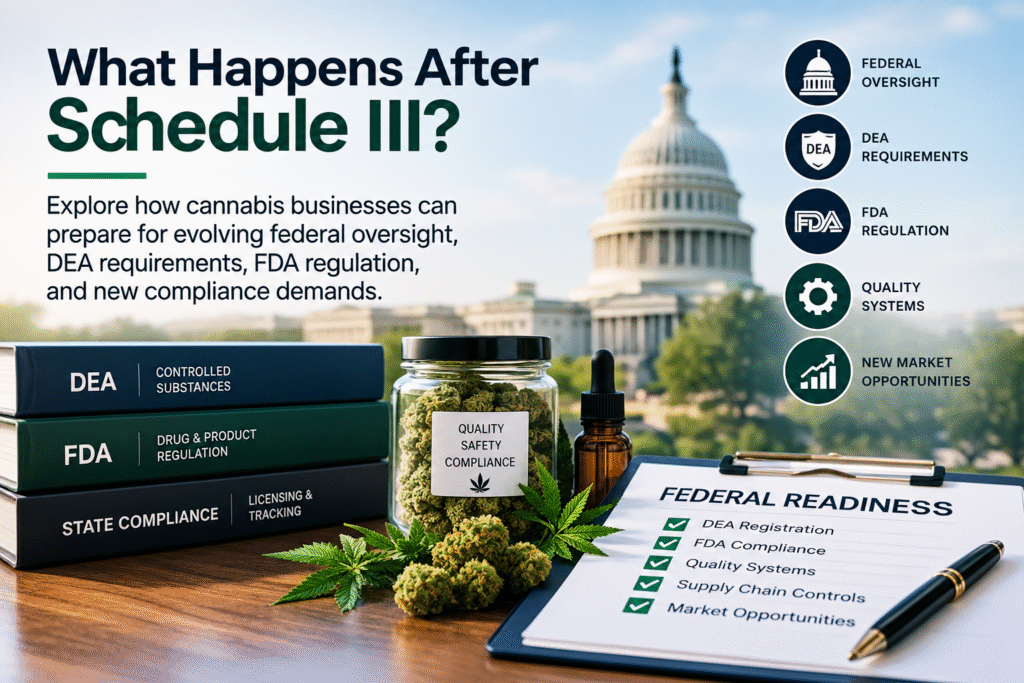

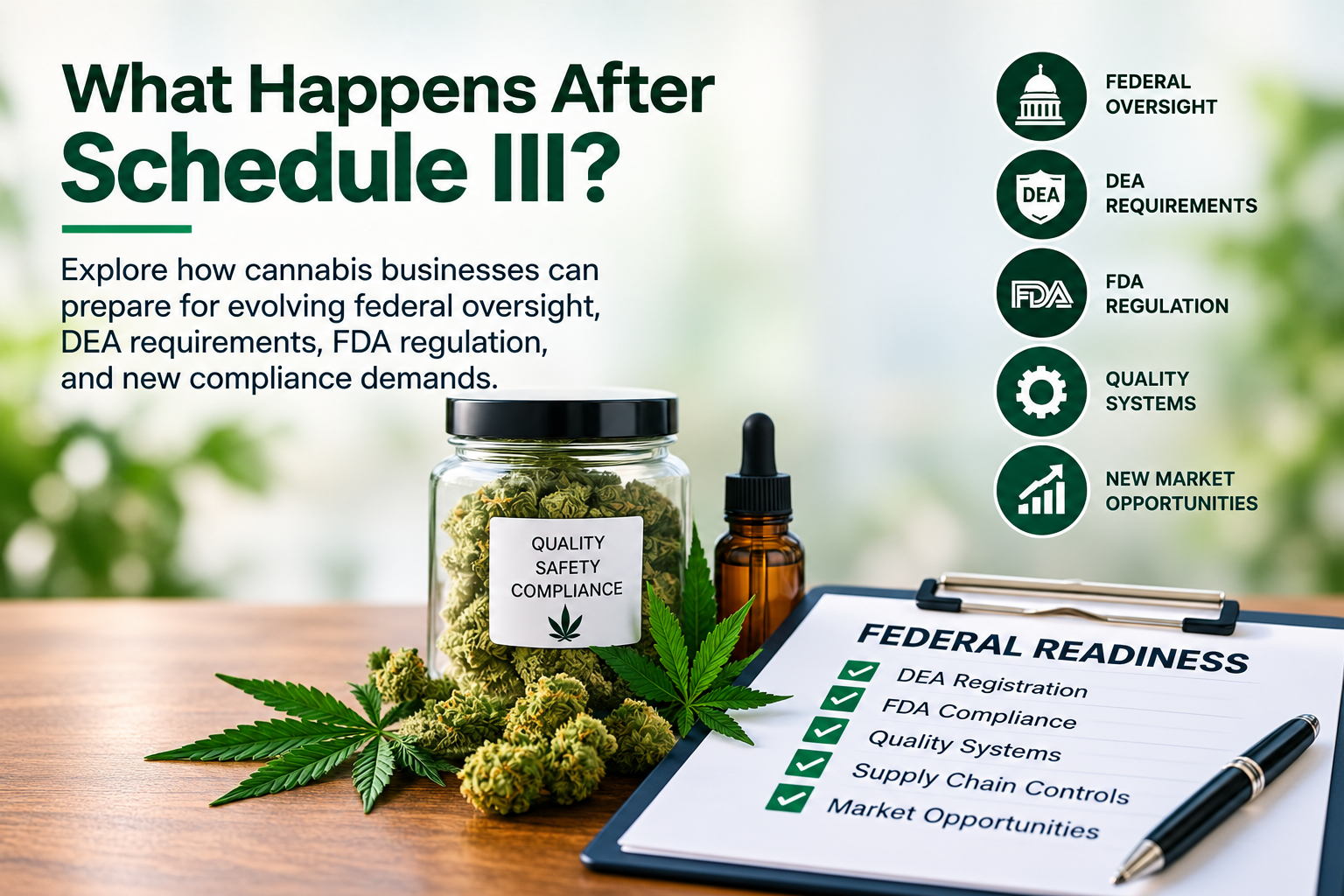
The Next Compliance Question for Cannabis
For years, cannabis businesses have talked about Schedule III as though it were a finish line.
Much of that attention is understandable. Internal Revenue Code Section 280E applies to businesses trafficking in Schedule I or II controlled substances, so moving marijuana to Schedule III has potentially significant tax implications for affected cannabis businesses. The IRS has continued to state that 280E applies while marijuana remains in Schedule I.
But taxation is only one part of a much larger regulatory question.
If marijuana moves to Schedule III, what happens next?
Does a state marijuana license suddenly become a federal license? Can existing cannabis products move freely across state lines? Can every dispensary sell federally lawful Schedule III drugs? Does FDA automatically approve products already being sold through state cannabis programs?
No.
Schedule III would represent a significant change in federal treatment of marijuana, but it would not by itself erase the distinction between state cannabis markets and federal controlled-substance and drug regulation.
For operators thinking beyond the tax implications, that distinction may become one of the most important compliance issues of the next several years.
Schedule III Has Already Started, But Not for Everything
The federal situation in 2026 is more nuanced than the headline “marijuana is being rescheduled.”
The Department of Justice has already issued a final rule placing FDA-approved marijuana products and marijuana products subject to state-issued medical marijuana licenses into Schedule III, along with an expedited DEA registration process for qualifying state medical marijuana licensees.
The broader question remains under formal rulemaking.
DEA held hearings from June 29 through July 15, 2026 concerning whether the remainder of marijuana should be transferred from Schedule I to Schedule III. DEA’s preliminary order expressly distinguished that proceeding from the medical marijuana products already addressed by the earlier rule.
That distinction matters.
It means operators should stop thinking about Schedule III as a single switch that Washington flips for the entire cannabis industry.
Federal cannabis policy is beginning to develop in layers.
And those layers may not treat every cannabis business — or every cannabis product — the same way.
Schedule III Is Still a Controlled Substance
Schedule III does not mean “uncontrolled.”
The Controlled Substances Act divides controlled substances among five schedules. Schedule III includes substances considered to have less abuse potential than Schedule I and II substances, but those substances remain federally controlled.
That distinction is important because the existing state cannabis industry was not built like the conventional federally regulated controlled-substance supply chain used for other drugs.
State cannabis regulators created their own systems for licensing cultivation, manufacturing, testing, transportation, tracking and retail sales. Businesses learned to operate within those systems.
Federal controlled-substance regulation introduces another framework.
DEA registration, recordkeeping and controlled distribution are familiar concepts throughout pharmaceutical and other controlled-substance industries. DEA guidance, for example, requires transaction records for Schedule III controlled substances and places responsibilities on suppliers to verify that customers are appropriately registered.
That doesn’t mean every state cannabis operator should immediately restructure itself around the conventional Schedule III pharmaceutical system.
DEA itself has previously explained that transferring marijuana to Schedule III would leave manufacture, distribution, dispensing and possession subject to applicable provisions of the Controlled Substances Act.
Schedule III changes the regulatory conversation.It doesn’t end it.
Then There Is FDA
This may be the part of the Schedule III conversation cannabis operators understand least.
DEA and FDA do different things.
DEA administers and enforces the Controlled Substances Act. FDA regulates products within its jurisdiction under laws including the Federal Food, Drug, and Cosmetic Act.
Changing marijuana’s schedule under the Controlled Substances Act does not automatically approve every existing cannabis product under federal food and drug law.
FDA currently states that it has not approved a marketing application for cannabis itself for the treatment of any disease or condition. The agency has approved one cannabis-derived drug, Epidiolex, and three synthetic cannabis-related drug products.
FDA drug approval is its own process involving evidence of safety, effectiveness, manufacturing quality and appropriate labeling.
That creates an important question for today’s cannabis industry:
What happens when products developed under state marijuana regulations begin interacting more directly with federal product regulation?
The answer will depend on the product, its intended use, the market in which it is sold, future federal policy and potentially additional legislation or regulation.
What businesses should not assume is that a state-approved cannabis product automatically becomes an FDA-approved product because marijuana changes schedules.
State Compliance and Federal Compliance Are Different Questions
This distinction may eventually force cannabis businesses to rethink what they mean when they say they are “compliant.”
A Colorado manufacturer may be compliant with Colorado Marijuana Enforcement Division rules.
A California cultivator may comply with California’s cannabis regulations.
A dispensary may successfully pass every inspection conducted by its state regulator.
Those facts matter.
But they don’t necessarily answer a future federal compliance question.
Federal frameworks may introduce different expectations surrounding registration, manufacturing practices, product claims, documentation, security, distribution, quality systems and other areas.
That doesn’t make state compliance irrelevant. Quite the opposite.
Businesses with mature state compliance programs already have much of the organizational foundation necessary to adapt to additional regulation.
The challenge is identifying what can carry forward and what would need to change.
The Quality-System Gap May Matter More Than the Rule Gap
Cannabis operators understandably spend considerable time tracking individual regulatory requirements.
But the largest transition for some businesses may not be learning another set of rules.
It may be learning another way of managing compliance.
Mature federally regulated industries tend to rely heavily on systems that demonstrate not only what a business intends to do, but how it controls and verifies what actually happens.
That includes concepts familiar to many sophisticated cannabis operators already: document control, employee training, supplier qualification, change management, complaint handling, traceability, internal auditing, corrective and preventive action, and quality management.
Manufacturing environments may face additional expectations surrounding process controls, specifications, validation and good manufacturing practices depending upon the federal pathway involved.
Cultivation operations considering pharmaceutical or international supply chains may similarly encounter agricultural and quality standards beyond those imposed by their state marijuana regulator.
Not every operator needs every one of these systems.
But operators should understand the gap between meeting today’s minimum state requirements and demonstrating that an operation is controlled, repeatable and verifiable.
That gap could become increasingly important.
Adult-Use Cannabis Presents a Different Question
Medical marijuana and adult-use marijuana should not automatically be treated as the same federal policy problem.
The federal government has already taken specific action concerning state-regulated medical marijuana products, while the broader DEA proceeding considers the remaining marijuana covered by the Controlled Substances Act.
Adult-use markets therefore have additional questions ahead.
Even if marijuana is broadly transferred to Schedule III, rescheduling alone does not create a comprehensive federal adult-use regulatory system. DEA has previously made clear that Schedule III status would still leave marijuana subject to applicable federal controlled-substance restrictions.
That means additional federal policy decisions would still matter enormously.
Congress could legislate. Federal agencies could establish additional rules within their authority. States could modify their own programs in response. Different pathways could emerge for hemp, medical, pharmaceutical, adult-use, interstate, and internationally traded cannabis.
Nobody should pretend those outcomes are settled today.
For businesses, the practical lesson is that there may not ultimately be one cannabis regulatory pathway.
There may be several.
Don’t Turn Your Dispensary Into a Pharmaceutical Company Yet
All of this creates an obvious temptation for compliance consultants:
Tell every cannabis business that federal regulation is coming and sell them an expensive federal-readiness overhaul.
That isn’t our advice. Though the international space certainly requires higher standards.
A Colorado dispensary does not need to become CVS.
A small cultivator shouldn’t pursue pharmaceutical certifications simply because marijuana may be rescheduled.
And a manufacturer operating entirely within one state shouldn’t spend hundreds of thousands of dollars implementing systems without understanding whether they serve an actual regulatory or commercial objective.
Preparation should be proportional.
Start by asking where your business intends to go.
- Are you remaining a local adult-use operator?
- Do you operate in a medical market?
- Are you manufacturing products that could eventually enter federally regulated channels?
- Are you planning to expand into additional states?
- Are you seeking institutional investment?
- Could your cultivation or manufacturing operation eventually participate in international cannabis trade?
The appropriate level of preparation depends heavily on those answers.
Federal Readiness Starts With What You Already Have
For most operators, the first step shouldn’t be buying something new.
It should be evaluating what already exists.
- Look at your SOPs.
- Look at training.
- Look at inventory and traceability.
- Look at supplier qualification.
- Look at how deviations and mistakes are documented.
- Look at your CAPA program.
- Look at complaint recall procedures.
- Look at quality controls.
- Look at document management.
Then ask a simple question:
Could we demonstrate that these systems actually work?
If the answer is yes, you already have a stronger foundation for whatever comes next.
If the answer is no, improving those systems can benefit the business today regardless of what ultimately happens with federal marijuana policy.
That is the kind of preparation that makes sense during uncertainty.
The Bigger Change May Be Recognition
For more than a decade, legal cannabis has operated as a collection of regulatory islands.
Colorado created one system. California created another. New York created another. Medical markets developed differently from adult-use markets. International jurisdictions developed their own licensing, quality and import/export requirements.
Each system can determine whether a business is compliant within its borders.
The harder question is what happens when those systems begin interacting.
- How does one regulator trust a license issued somewhere else?
- How does a buyer verify that a product meets another jurisdiction’s requirements?
- How do businesses demonstrate that cultivation, manufacturing, testing and documentation satisfy the standards of the market receiving the product?
Schedule III doesn’t answer those questions. But it makes them harder to ignore as cannabis moves beyond State borders.
The next phase of cannabis compliance may therefore be less about writing another SOP for another isolated license and more about creating systems capable of demonstrating compliance between regulated markets.
That is a much larger challenge — and potentially a much larger opportunity.
What Happens After Schedule III?
The answer isn’t simply lower taxes. And it isn’t instant federal legalization.
Schedule III changes marijuana’s position within federal controlled-substance law. From there come questions involving DEA registration and control, FDA authority, state regulation, medical versus adult-use markets, manufacturing standards, product pathways, interstate activity and eventually international commerce.
Some of those questions have answers today. Many don’t.
Cannabis businesses don’t need to solve all of them now.
They do need to understand which ones could matter to their business.
After 15 years helping operators navigate cannabis regulation, that’s increasingly where we believe compliance planning should begin — not with another binder of rules, but with understanding where the business is trying to go and what systems it will need to get there.
Start With the Question That Matters to Your Business
If you’re wondering what Schedule III or greater federal oversight could mean for your particular operation, iComply offers two ways to start.
A complimentary 30-minute conversation can help identify whether there is a meaningful federal-readiness issue for your business and whether additional work is warranted.
For businesses with specific questions about operations, quality systems, expansion, investment readiness or potential federal requirements, our services and advice is priceless and provides time to work through the issue in detail and identify practical next steps.
Schedule a Complimentary 30-Minute Call
Schedule III may answer one of cannabis’s oldest federal questions.
It may also begin asking a whole new set of them.
The businesses that understand the difference will be better prepared for what comes next.