

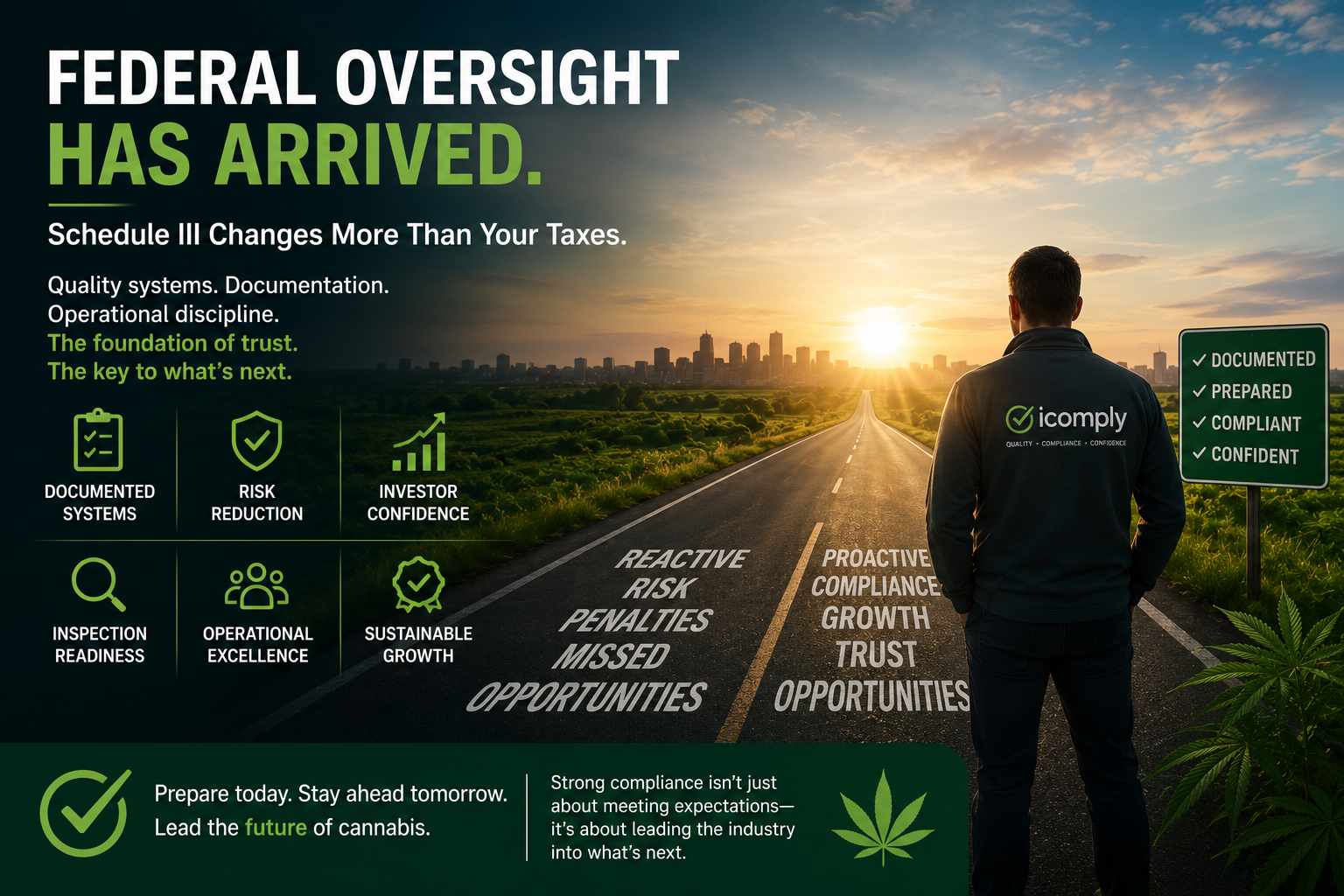
Schedule III Changes More Than Your Taxes
For the past several years, conversations about federal cannabis reform have revolved around a handful of familiar topics.
280E.
Banking.
Investment.
Interstate commerce.
Those are all important, and they deserve the attention they’ve received. But they may not be the most significant change operators should be preparing for.
The real shift isn’t simply that cannabis is becoming more accepted federally.
It’s that federal oversight is beginning to emerge in an industry that has largely been regulated state by state for more than a decade.
Recent reports indicate that the DEA has begun conducting on-site visits at state-licensed medical marijuana businesses participating in the new federal registration process. While these early interactions appear to be collaborative and part of implementing the new framework, they signal something much larger:
Federal compliance is no longer theoretical. It’s beginning to take shape.
State Compliance Is the Foundation — Not the Finish Line
For years, operators have worked hard to understand and comply with state regulations.
Those regulations have required extensive documentation, inventory tracking, testing, security, employee training, and operational controls.
None of that work goes away.
In fact, those businesses that have invested in robust compliance programs are likely to be in the strongest position as federal oversight evolves.
But it’s important to recognize that state compliance and federal compliance are not identical concepts.
Federal agencies often evaluate operations through a broader quality management lens—one built on consistency, accountability, documentation, and process control.
The question becomes less:
“Did you follow this rule?”
And more:
“Can you demonstrate that your systems consistently produce compliant results?”
What Federal Oversight Typically Looks Like
Every federally regulated industry—whether pharmaceutical manufacturing, food production, medical devices, or controlled substances—shares common expectations.
Inspectors want to understand not only what you do, but how you ensure it is done consistently.
That generally means evaluating areas such as:
- Document control and version management
- Employee qualifications and documented training
- Inventory accountability and traceability
- Security and controlled access
- Chain of custody throughout production and distribution
- Equipment calibration and maintenance
- Corrective and Preventive Action (CAPA)
- Internal auditing and continuous improvement
- Complaint handling and investigations
- Record retention and data integrity
These concepts are not unique to cannabis.
They are the language of modern quality systems. Most cannabis businesses aren’t there yet.
The Growing Importance of GMP and GACP
Two frameworks are likely to become increasingly familiar to cannabis operators over the coming years.
Current Good Manufacturing Practices (cGMP)
For manufacturers, cGMP focuses on producing products consistently and controlling manufacturing processes through documented procedures, validated systems, employee training, sanitation, equipment maintenance, and quality assurance.
The objective isn’t simply producing a compliant product.
It’s proving that every product is produced through a repeatable, controlled process.
Good Agricultural and Collection Practices (GACP)
Cultivation businesses face similar expectations.
GACP emphasizes:
- cultivation practices
- environmental controls
- sanitation
- pesticide management
- harvesting procedures
- storage conditions
- traceability
- documentation
The goal is ensuring consistent quality from seed through harvest while minimizing contamination risks before products ever reach manufacturing.
Quality Systems Become Competitive Advantages
Many operators still think of compliance as a cost center. Increasingly, it will become a business asset.
The same quality systems that help satisfy regulators also build confidence with:
- investors
- lenders
- insurers
- strategic partners
- acquisition teams
Strong documentation.
Reliable inventory systems.
Well-maintained SOPs.
Meaningful CAPA investigations.
These aren’t simply compliance exercises anymore.
They’re evidence of operational maturity.
This Isn’t About Becoming a Pharmaceutical Company Overnight
It’s important to keep this transition in perspective.
No one expects every state-licensed cannabis operator to immediately function like a multinational pharmaceutical manufacturer.
Federal agencies themselves are entering unfamiliar territory as they begin implementing this new framework.
Expectations will evolve.
Guidance will continue to develop.
The industry will adapt.
But businesses that begin strengthening their quality systems today will be significantly better positioned than those waiting until new requirements become mandatory.
Preparing Today for Tomorrow’s Expectations
Whether federal oversight develops gradually or accelerates over the coming years, one thing is becoming increasingly clear:
Businesses with mature compliance systems will have more options.
More financing opportunities.
Greater investor confidence.
Smoother regulatory interactions.
And greater flexibility as federal policy continues to evolve.
Preparing now isn’t about predicting every future regulation. It’s about building an organization capable of adapting to them.
Final Takeaway
Schedule III represents far more than tax relief or new business opportunities.
It represents the beginning of a new chapter for the cannabis industry.
One where quality systems, documentation, accountability, and operational discipline will increasingly define successful operators.
Federal oversight shouldn’t be viewed as something to fear.
It should be viewed as an opportunity to elevate the professionalism and credibility of an industry that has spent decades proving it deserves a place in the legitimate economy.
The operators who recognize that today won’t simply be ready for federal oversight. They’ll help define what that future looks like.
Federal Readiness Starts Before the Inspector Arrives
As cannabis moves toward greater federal oversight, preparing for the future means more than checking today’s regulatory boxes. At iComply, we help operators evaluate their readiness through comprehensive assessments of quality systems, SOPs, documentation, inventory controls, CAPA programs, security, and operational practices against emerging federal expectations.
Because when federal oversight arrives, the strongest operators won’t be the ones scrambling to catch up—they’ll be the ones who have been preparing all along.